Here is a number to think about – the average eCommerce conversion rate across industries is between 2% and 3%. That means for every 100 visitors your SEO brings to your store, 97 to 98 of them leave without buying anything. If your entire SEO strategy is built around driving more of those visitors, you are optimizing for the wrong outcome.
Ranking high on Google is NOT the goal. Revenue is the goal. Traffic is just the input.
And in 2026, with AI Overviews absorbing informational clicks before they reach your site and zero-click searches at an all-time high, even the traffic number is becoming an unreliable signal of SEO health.
Understand What eCommerce SEO Actually Means in 2026
eCommerce SEO is the practice of optimizing an online store's visibility in search engines to attract high-intent shoppers, those actively looking to browse, compare, or buy, and converting that visibility into measurable revenue.
It goes well beyond rankings. Done correctly, eCommerce SEO is about getting the right people to the right pages at the right moment in their buying journey. A page ranking for a high-volume keyword that attracts curious browsers but never converts is not an SEO win; it is a budget drain dressed up as one. Revenue-driven ecommerce SEO starts with purchase intent, not search volume.
Why Traffic Alone No Longer Defines SEO Success
The old playbook was pretty straightforward.
Rank higher, get more traffic, make more sales.
That logic worked reasonably well when most search clicks landed on organic results. It is considerably less reliable today.
Google AI Overviews now appear in over half of all searches, answering informational queries directly on the results page. Users get what they need without ever clicking through to your site. Rankings hold. Traffic falls. Sessions drop even when positions improve. For eCommerce teams measuring success by organic session counts, this creates a genuinely misleading picture, where SEO appears to be declining when it may actually be performing well for the keywords it targets.
The deeper problem is intent mismatch. Informational keywords drive traffic. Transactional keywords drive revenue. Most e-commerce sites inadvertently invert this relationship. They invest heavily in content that attracts readers and very little in the product and category page optimization that converts buyers.
The result is the vanity metric trap, where you are bewitched by high session counts, low conversion rates, confident-looking dashboards, and underwhelming revenue. That is not an SEO success story. It is a measurement failure.
Understanding Search Intent — Match Your Keywords to Buyer Intent Before Anything Else
Before any keyword research, content creation, or page optimization, there are two questions you should ask.
Will your eCommerce SEO strategy generate revenue or simply generate traffic? And what does the person typing this query actually want?
Search intent falls into four categories.
- Informational intent that covers queries like “how do running shoes work”. People who are gathering knowledge and are not ready to buy immediately fall under this category.
- Navigational intent includes queries such as “Nike official store”. People who are looking for a specific destination are classified as having navigational intent.
- Commercial intent covers queries like “best running shoes for flat feet”. This category includes people who are actively researching before making a purchase decision.
- Transactional intent covers queries like “buy Nike Air Zoom size 10 free shipping”. These folks have their credit cards ready and primed to drop some cold, hard cash.
Only the last two categories reliably drive eCommerce revenue. Yet informational keywords typically have the highest search volumes, so they dominate most keyword research outputs and attract the most content investment. The e-commerce SEO strategy that wins is the one that maps keywords by intent first, using informational content as an entry point that leads toward commercial pages, not as an end destination in itself.
9 eCommerce SEO Strategies That Drive Real Revenue
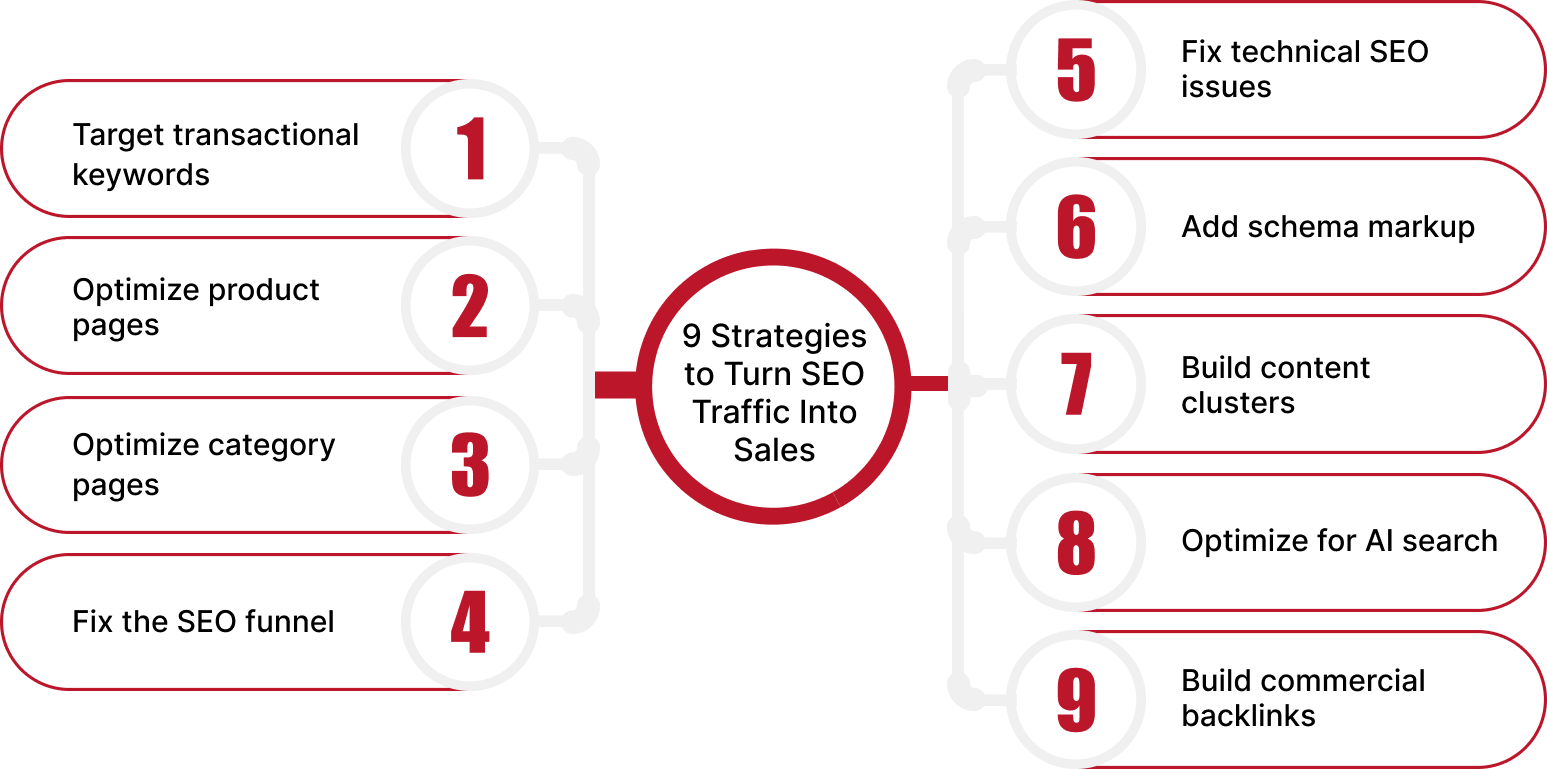
1. Target Transactional and Commercial Keywords
The most direct lever in eCommerce SEO optimization is keyword selection. Prioritize queries containing purchase signals, such as “buy,” “best,” “cheap,” “deals,” “review,” “vs,” and product-specific searches.
These keywords convert.
High-volume informational terms may inflate traffic metrics, but they rarely appear in the attribution path of a completed sale.
Use keyword research tools with intent filters to identify which terms in your target list are actually commercial or transactional. Volume alone is not just misleading; it is actively deceptive when used as the primary selection criterion.
2. Optimize Product Pages for Both Rankings and Conversions
SEO gets users to your product page. The page itself has to close the deal. Most eCommerce product pages fail at both simultaneously – thin content that does not rank and generic descriptions that do not convert.
Strong product page optimization covers title tags and meta descriptions with specific, intent-matched language; unique product descriptions that describe benefits, not just specifications; high-quality images with descriptive alt text; customer reviews that both build trust and generate natural keyword variation; and product schema markup that enables rich results. Duplicate product descriptions, particularly across size and color variants, are the single most common eCommerce SEO mistake and one of the fastest things to fix.
3. Optimize Category Pages
Category pages are the most underutilized asset in most e-commerce sites. They sit at the intersection of high commercial intent and significant search volume, and they carry more topical authority than individual product pages. Yet most brands treat them as navigation menus rather than SEO landing pages.
Add keyword-rich introductory copy above the product grid. Build internal linking structures that connect related categories. Implement faceted navigation carefully; filters that generate unique URLs for every combination create duplicate content at scale, which is a crawlability and indexation problem that quietly suppresses rankings across the entire site.
4. Fix the Hidden SEO Funnel
Most e-commerce sites have content and product strategies that exist in parallel without connecting. Blog content attracts informational traffic that lands, reads, and leaves. Product pages attract transactional traffic that either converts or bounces. The gap between them, i.e., the consideration phase where a prospective buyer is comparing, evaluating, and building purchase intent, is where most SEO-driven revenue is lost.
The fix is deliberate funnel mapping. Every piece of content should serve a stage:
- Awareness content introduces the category and problem
- Consideration content compares options and builds preference
- Purchase content removes friction and drives the transaction
Internal links should move users actively from earlier stages to later ones, from the blog post about “how to choose a standing desk” to the standing desk category page to the specific product page that matches what they described.
5. Technical SEO That Directly Impacts Revenue
Conversion rate optimization for e-commerce starts before a user even sees your page. Page speed is both a ranking factor and a conversion factor. Even a one-second delay in load time can reduce conversions by 7%, as per a study by Akamai. Core Web Vitals scores directly affect Google rankings. Mobile UX determines whether a user on a phone can actually complete a purchase.
Prioritize technical fixes on product and category pages first. These pages have the highest revenue potential per visitor; a crawl error or indexation issue on a top-converting product page costs you money every day it remains unfixed. Blog content crawl errors are an inconvenience. Product page crawl errors are revenue losses.
6. Schema Markup for Rich Results
Schema markup is one of the highest-ROI technical investments available to an eCommerce site. Product schema, price schema, review schema, and availability schema all enable rich results in Google, specifically those expanded listings that show star ratings, price ranges, and stock status directly in the search results page.
Rich results drive higher click-through rates from the same ranking position. More importantly, they attract more qualified clicks; users who saw your price and rating before clicking are more purchase-ready than those who clicked on a generic blue link. This is increasing e-commerce conversions happening before the user even reaches your site.
7. Build Topical Authority With a Content Cluster Strategy
Standalone blog posts targeting individual keywords are an inefficient approach to content-driven SEO. A content cluster strategy in which pillar pages covering broad category topics are supported by a network of related blog posts targeting specific questions and subtopics builds topical authority in ways that individual posts cannot.
For e-commerce, pillar pages map naturally to category or subcategory pages. The blog content supporting them addresses the informational and commercial queries surrounding the purchase decision. Internal links from blog posts to product and category pages pass authority downward and create navigation pathways that move users from research to purchase. This is performance-based SEO in its most practical form, where every piece of content is designed to contribute to a revenue outcome, not just a traffic number.
8. Optimize for AI Search and Voice Commerce
Conversational queries are growing as a share of search volume, driven by voice search, AI assistants, and the way users naturally phrase questions to ChatGPT and Perplexity. “What is the best affordable espresso machine for a small kitchen?” is a voice query. It is also a commercial-intent query that your structured content should answer.
FAQ schema captures these conversational queries and can appear in AI Overviews and featured snippets. Natural-language product descriptions and category page copy that mirror how buyers actually talk about products improve relevance when matching these long-tail queries. Structured product data, such as a properly implemented schema across your entire catalog, makes your inventory visible to AI shopping assistants and Google's AI-powered shopping features, which are becoming a meaningful channel for traffic and conversions.
9. Build High-Quality Backlinks to Product and Category Pages
Most e-commerce link building ends up concentrated on blog content because blog posts are easier to pitch for links. The problem is that blog content is rarely where the rankings that drive revenue actually matter. A high-authority backlink to a category page can have ten times the commercial impact of the same link pointing to a blog post.
Actively build links to your commercial pages. Digital PR campaigns that generate product coverage in relevant publications, supplier and manufacturer link opportunities from brands whose products you carry, niche industry directories, and affiliate relationships can all drive links directly to product and category pages. This is SEO for e-commerce sales in its most targeted form, where every link built should be evaluated by whether it improves rankings on pages that convert.
Key Metrics for Revenue-Driven eCommerce SEO
The key metrics that matter in a revenue-driven program for e-commerce SEO include:
- Organic revenue: Total sales directly attributed to organic search in your analytics platform. This is the headline number. Everything else supports it.
- Organic conversion rate: The percentage of organic visitors who complete a purchase. This reveals whether your traffic quality is improving or just your traffic volume. An improving organic conversion rate indicates that your intent targeting is working.
- Revenue per organic visit: This metric captures both traffic quality and conversion efficiency in a single metric and is the clearest measure of whether your organic traffic conversion rate is moving in the right direction.
- Keyword intent mix: The percentage of your ranking keywords that are commercial or transactional versus informational. A portfolio shifting toward a higher commercial-intent share is a program moving in the right direction, even if total ranking counts remain flat.
- Assisted conversions: SEO's contribution to multi-touch purchase journeys in GA4. Most eCommerce purchases involve multiple sessions across multiple channels. Assisted conversion data reveals organic search's role in journeys that completed through another channel, ensuring SEO's full revenue contribution is attributed correctly.
Avoid These 5 eCommerce SEO Mistakes Before They Cost You Sales
Knowing what not to do is as valuable as knowing what to do. These five mistakes consistently suppress eCommerce SEO revenue regardless of how well everything else is executed:
Mistake #1: Targeting high-volume informational keywords with no purchase pathway
Ranking for “what is a standing desk” when you sell standing desks is only valuable if that content leads users toward a purchase. Without an internal linking strategy connecting it to commercial pages, the traffic has no revenue ceiling.
Mistake #2: Neglecting product and category page SEO in favor of blog content
Blog posts are easier to write and easier to get links for, so they get disproportionate investment. The pages that actually convert, such as the product and category pages, get the leftover budget.
Mistake #3: No CRO layer alongside SEO
Traffic arrives, and nothing converts it. eCommerce SEO without conversion-rate thinking is like filling a leaky bucket, where work keeps going in and results keep disappearing.
Mistake #4: Duplicate product descriptions across variants
Color and size variants with identical descriptions create duplicate content that cannibalizes rankings across your own catalog. Every variant that can be differentiated should be.
Mistake #5: Measuring success by rankings or sessions rather than revenue
This is the root cause of every other mistake on the list. When the metric changes to revenue, the strategy changes with it.
Rank for Intent. Optimize for Conversion. Measure by Revenue.
In 2026, eCommerce SEO is no longer just about driving traffic. It is about driving revenue, with organic search serving as its primary channel. The brands that succeed are those that have shifted their focus from rankings to conversions and from page views to sales.
Audit your keyword strategy for intent. Review your top-traffic pages and ask whether they lead customers naturally toward a purchase. Check whether your product and category pages are getting the same SEO investment as your blog. And when evaluating performance, prioritize organic revenue over metrics like rankings or sessions.
If you want help building an eCommerce SEO strategy around revenue rather than traffic, an SEO audit is a good place to start. At Intelegencia, we offer tailored e-commerce SEO services to position your brand in front of high-intent users exactly when they’re looking for what you offer. We can map your current keyword intent mix and identify the highest-priority pages for optimization. That is where the revenue gap usually lives, and the easiest wins are hiding.